
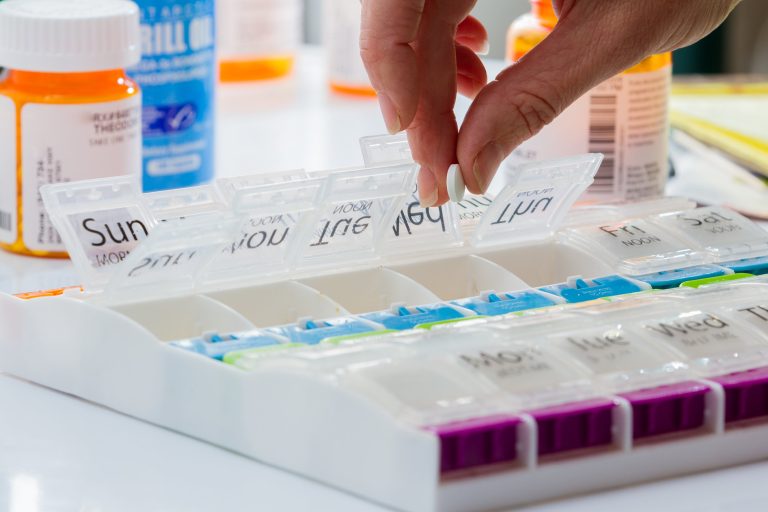
Medication management in mental health is ongoing care from a psychiatrist or psychiatric nurse practitioner who evaluates your symptoms, prescribes medication when it makes sense, checks how it is working, and adjusts the plan over time. It is not a single appointment where you leave with a prescription. It is a series of visits where you and the prescriber keep track of what is helping, what is not, and what to change.
At Sacramento NeuroPsych Associates, psychiatric medication management is available in person in Folsom and Rocklin or by secure video anywhere in California, for children, adolescents, and adults. Here is what the service involves and what each visit looks like.
What does medication management actually involve?
Four things happen over and over, in a loop:
- Evaluation. The prescriber learns what you are experiencing, how long it has been going on, and what you have already tried.
- Prescribing. If medication is appropriate, the prescriber chooses one with you, explains what it is for, and sends the prescription to your pharmacy.
- Monitoring. At follow-up visits you report how you feel, any side effects, and anything that has changed. Some medications also call for lab work.
- Adjusting. Based on what you report, the prescriber may hold steady, change the dose, switch medications, add something, or start a plan to taper off.
The loop matters because people respond differently to psychiatric medications, and finding an option that works and is tolerable may take more than one try. The National Institute of Mental Health notes that it can take several tries to find the medication that works best, and that antidepressants usually take 4 to 8 weeks to work, with sleep, appetite, energy, and concentration often improving before mood does (NIMH, Mental Health Medications). Medication management is the structure that gets you through that stretch safely instead of guessing on your own.
Who provides psychiatric medication management?
At our practice, psychiatric medication management is provided by two kinds of clinicians: psychiatrists, who are medical doctors (MD or DO) with residency training in psychiatry, and psychiatric mental health nurse practitioners (PMHNPs), advanced-practice nurses with graduate training in psychiatry. Both evaluate, diagnose, and prescribe. Therapists and psychologists generally do not prescribe.
Our practice has both. Board-certified psychiatrists such as Dr. Harjot Sekhon and Dr. Manish Aggarwal see children, adolescents, and adults, and nurse practitioners Julie McKown and Naveet Johal provide ongoing medication care for depression, anxiety, ADHD, OCD, and related conditions. If you are still deciding what kind of clinician you need, our guide on how to choose a psychiatrist in Sacramento walks through the differences.
What happens at the first appointment?
The first visit is a psychiatric evaluation. At our practice it runs 30 to 60 minutes, in the office or by video. The prescriber asks about your current symptoms, when they started, past treatments, other medical conditions, medications and supplements, family history, sleep, and substance use. Bring a list of every psychiatric medication you have tried and what happened with each.
At the end, the prescriber shares their impression and talks through options, including non-medication options. You decide together. Sometimes a prescription starts that day. Sometimes the plan is to gather more information first, such as an attention test as part of an ADHD evaluation.
What happens at follow-up visits?
Follow-ups are where the "management" part happens. They are generally shorter than the first visit and focus on a few questions:
- How are the target symptoms compared with last time?
- Are there side effects, and are they tolerable?
- Are you taking the medication as prescribed, and is anything making that hard?
- Has anything changed: a new diagnosis, a new medication from another doctor, pregnancy, a big life stressor?
- Do you need lab work? NIMH notes that some medications require regular monitoring, for example lithium levels along with kidney and thyroid function, or weight, glucose, and lipids with some antipsychotics.
Then the prescriber decides with you whether to hold steady, adjust, or change course. If something is not working, say so plainly. The visit exists for that.
One safety point worth knowing before you start: FDA-approved prescribing information for antidepressants directs that all patients be observed closely for clinical worsening, suicidal thoughts, or unusual changes in behavior, especially during the first few months and at times of dose changes (Zoloft prescribing information, DailyMed). NIMH adds that children, teens, and young adults under 25 may be at higher risk. This is why follow-ups tend to be closer together at the beginning, and why you should contact the office between visits if you notice something concerning.
How often will I have appointments?
It depends on where you are in treatment. In general, visits are closer together when a medication is new or has just been changed, and spread out once you have been stable for a while. Someone starting a first antidepressant will usually be seen more often than someone who has done well on the same medication for a year.
We do not put a number on this here, because your prescriber sets the schedule based on your situation. Ask at your first visit what cadence to expect, and again whenever the plan changes.
Can I do medication management by telehealth?
Yes. Our telehealth visits are secure, HIPAA-compliant video appointments of 30 to 60 minutes, available anywhere in California, for evaluations, medication management, and follow-ups. Ask whether your first evaluation and your follow-ups can be done by video, in person, or a mix of both. A TelePsych consent form is required before your first video visit; the office will point you to it.
Some medications and situations still call for an in-person visit, and your prescriber will tell you if that applies to you. Telehealth is also not for emergencies. If you are in crisis or thinking about harming yourself, call or text 988 (Suicide and Crisis Lifeline) or call 911.
What conditions is medication management used for?
At Sacramento NeuroPsych Associates, medication management is used for depression, anxiety disorders, ADHD, bipolar disorder, OCD, PTSD, schizophrenia, and related conditions, in children, adolescents, and adults. The medication classes involved are the ones NIMH describes: antidepressants, anti-anxiety medications, stimulants for ADHD, mood stabilizers for bipolar disorder, and antipsychotics. Which class, and which medication within it, depends on the diagnosis and on your history.
Medication is not required to be seen. If the evaluation suggests therapy alone, or a different approach, your prescriber will say so. Many people do both, and with your consent our prescribers can coordinate with your therapist.
What if the medication is not working?
This is common, and it is what the follow-up loop is for. The usual first steps are to confirm the dose and the time on it, then adjust, switch, or combine. If you have tried two or more antidepressants without enough relief, read about treatment-resistant depression and the options in Sacramento. Because our practice also offers TMS therapy and Spravato (esketamine), the next step after medication alone can happen under the same roof.
Whatever you do, do not stop or change a psychiatric medication on your own. NIMH is direct about this: people should not stop taking a prescribed medication even if they are feeling better, because a provider can lower the dose gradually and safely. Call the office first.
Psychiatric medication management in Sacramento: Folsom, Rocklin, and telehealth
Our offices are in Folsom at 2150 E. Bidwell St. and Rocklin at 6000 Fairway Dr., Suite 14, with a Natomas office opening soon. Both current offices offer medication management in person, and you can also see a provider by video. Between visits, patients use the Patient Ally portal for messages, documents, and appointment details.
We accept more than 18 insurers, including Medicare, Medi-Cal, and major commercial plans; the full list is on our insurance page. Accepting a plan is not the same as a specific service being covered, so check your benefits, and ask whether your plan needs a referral before a psychiatry visit.
Frequently asked questions
Do I have to stay on medication long-term?
Not everyone needs medication long-term. Some people use it for a limited period, while some conditions, such as bipolar disorder or schizophrenia, often call for ongoing treatment to lower the risk of relapse. Your prescriber will go over the benefits, risks, and expected length of treatment with you, and the plan is reviewed at every visit. Our aim is the lowest effective dose that keeps you well, and any taper is planned with your prescriber, never abrupt.
How long does it take for psychiatric medication to work?
It varies by medication and by person. NIMH gives 4 to 8 weeks as the usual window for antidepressants, with practical things like sleep and energy often improving first. Your prescriber will tell you what to expect for the specific medication you start.
What should I do if I have side effects or miss a dose?
Contact the office rather than waiting for your next visit. Many side effects can be managed by adjusting the plan, and your prescriber can tell you how to handle a missed dose for your particular medication. Do not double up or stop on your own.
Can my child or teen get medication management?
Yes. Our psychiatrists who practice child and adolescent psychiatry evaluate and treat kids and teens, in the office or by telehealth. For attention concerns, an evaluation may include T.O.V.A. testing alongside the clinical interview.
Take the next step
If you are weighing medication for the first time, or you have a prescription that no longer feels like it is doing its job, an evaluation is the place to start. Request an appointment in Folsom, Rocklin, or by video, or call (916) 473-2235. Describe what is going on in the "Reason for Visit" box and our team will help match you with the right service.